

Nature: Zhejiang University Proposes New Ideas for Regulating Reversible Plastic Deformation of Micro-nano Structural Materials


Release time:

2020-06-19

The structural stability and reliability of nanomaterials play a decisive role in the performance of nanodevices. Irreversible microstructure damage induced by stress/strain during long-term service often leads to device function degradation or even failure, and nanomaterials are prone to non-uniform nucleation during cyclic loading or deformation, which directly induces shear localization and material performance degradation.
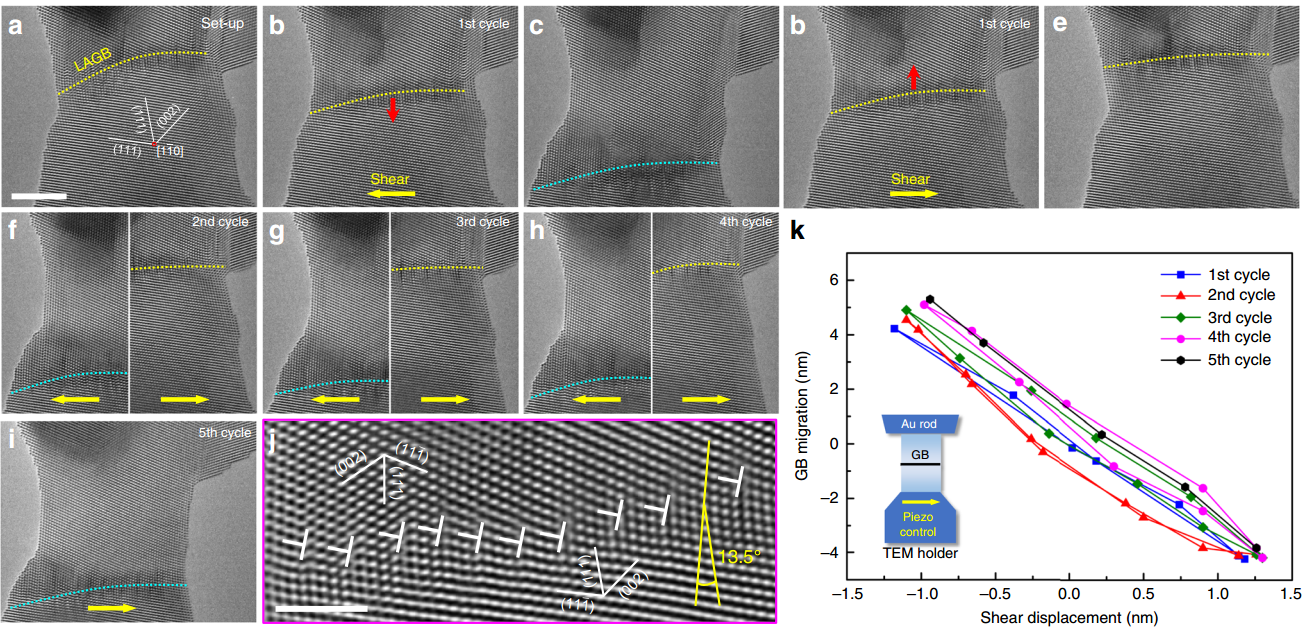
Recently, Academician Zhang Ze and Researcher Wang Jiangwei of the School of Materials Science and Engineering of Zhejiang University, in cooperation with Academician Z Xin Yang Wei and Researcher Zhou Haofei of Zhejiang University, proposed a new idea to realize controllable cyclic deformation of metal nanostructures through grain boundary regulation. The relevant results were published on Nature Communications under the title "Metallic nanocrystals with low angle grain boundary for controllable plastic reversibility.

Original Link: https://www.nature.com/articles/s41467-020-16869-3

1

Figure: Experimental Method

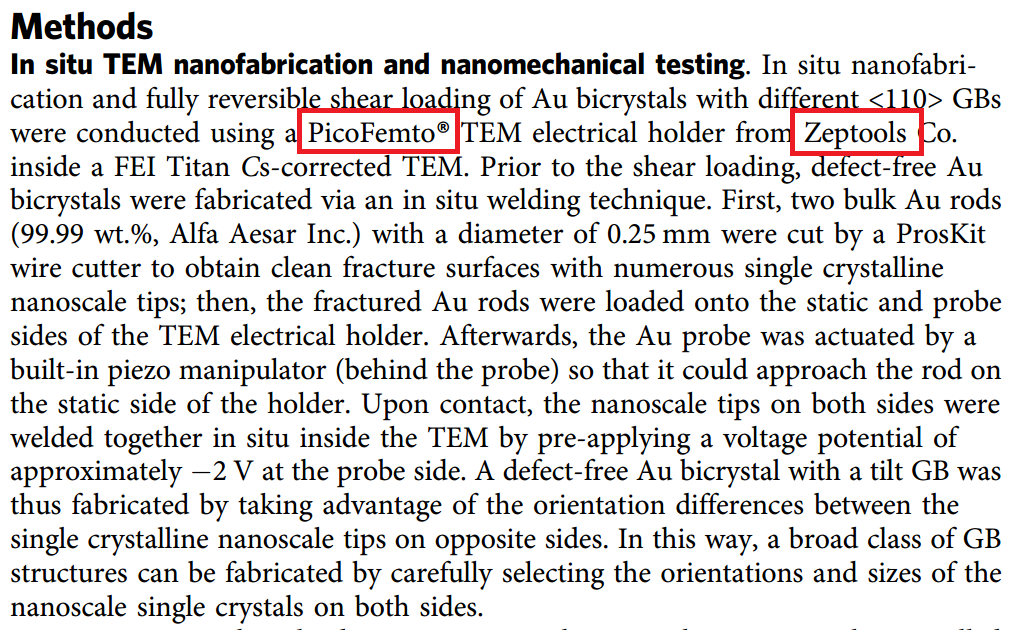
In this experiment, a block gold rod is cut by a wire cutting machine and placed on the PicoFemto®In situ TEM-STM electrical measurement on the sample rod, the researchers used the three-dimensional manipulation unit and electrical unit of the sample rod to accurately butt the two gold rods in the TEM, weld and prepare high-quality gold double crystal nanostructures. In-situ measurements and characterization are then performed by the mechanical loading function of the in-situ sample rod.

1

Figure: In Situ TEM Analysis
