



Nature Communications | ZEPTOOLS ZEM Series Desktop Scanning Electron Microscope Aids Development of Highly Stable Fiber-Integrated Graphene Ultrafast Electron Source
Release time:
2025-07-15
In the field of vacuum electronics, stable and durable ultrafast electron sources are critical for achieving high-precision time-resolved imaging and spectroscopic analysis. Traditional electron sources typically rely on metals such as gold and tungsten, or low-dimensional materials such as carbon nanotubes, as photocathodes, generating electron pulses through mechanisms such as multiphoton emission, the photoelectric effect, or optical field emission. However, these methods have significant limitations. On the one hand, multiphoton emission and optical field emission require ultra-high-power lasers or deep ultraviolet pulse excitation, leading not only to cathode material damage and mechanical vibration but also demanding extreme vacuum conditions. On the other hand, existing electron sources generally suffer from time-dependent beam current instability, requiring recalibration every 4–6 hours, which severely constrains equipment operational efficiency and data reliability.
In the field of vacuum electronics, stable and durable ultrafast electron sources are critical for achieving high-precision time-resolved imaging and spectroscopic analysis. Traditional electron sources typically rely on metals such as gold and tungsten, or low-dimensional materials such as carbon nanotubes, as photocathodes, generating electron pulses through mechanisms such as multiphoton emission, the photoelectric effect, or optical field emission. However, these methods have significant limitations. On the one hand, multiphoton emission and optical field emission require ultra-high-power lasers or deep ultraviolet pulse excitation, leading not only to cathode material damage and mechanical vibration but also demanding extreme vacuum conditions. On the other hand, existing electron sources generally suffer from time-dependent beam current instability, requiring recalibration every 4–6 hours, which severely constrains equipment operational efficiency and data reliability.

Although ultrafast electron sources have made progress in microscopy in recent years, material damage, complex driving mechanisms, and environmental sensitivity remain core bottlenecks limiting their widespread application. Graphene has emerged as a breakthrough solution due to its unique carrier dynamics. Hot carriers in graphene achieve energy upconversion and Dirac band distribution through ultrafast electron-electron scattering, with thermalization efficiency far exceeding that of traditional metals. This mechanism allows graphene to generate high-energy hot electron emission under near-infrared low-power laser excitation (approximately 1 GW/cm²) while maintaining a low lattice temperature (<400 K), thereby avoiding thermal evaporation damage to the material. Moreover, the in-plane carbon bonding structure and dangling-bond-free surface of graphene endow it with excellent mechanical stability. However, existing research has mostly focused on static hot electron emission. How to leverage the ultrafast thermalization characteristics of hot carriers in graphene to construct compact, long-life electron sources, and how to solve the problems of optical vibration and focus drift in free-space excitation mode, remain technical challenges to be overcome.
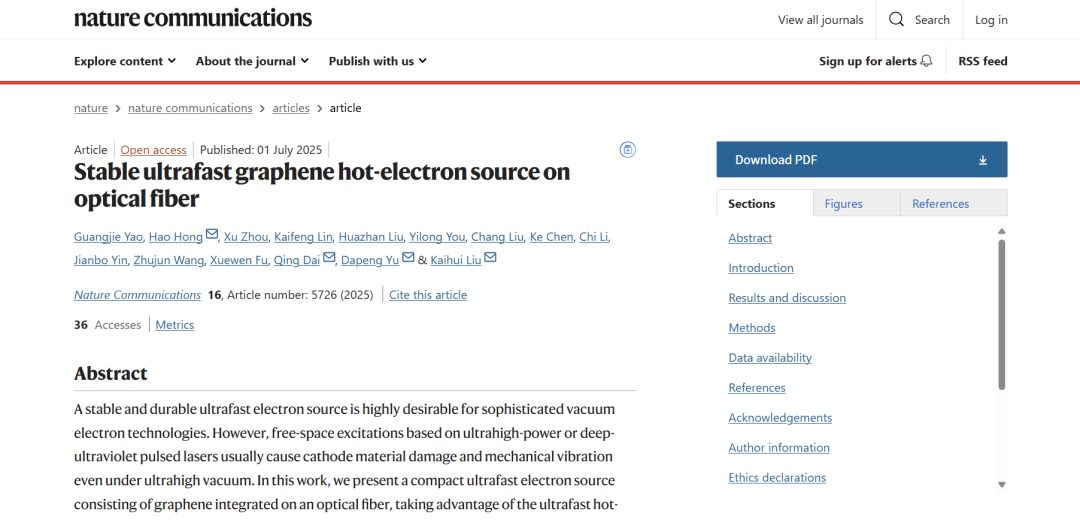
To address the above issues, a research team from Peking University and other institutions conducted in-depth research using the ZEPTOOLS ZEM series desktop scanning electron microscope. The team innovatively adopted a single-mode fiber as the laser transmission medium, whose stable Gaussian beam mode fundamentally suppresses optical drift in free-space excitation. This design precisely confines the electron emission region to the fiber end face, and combined with the atomic-level thickness of graphene, achieves the generation of 80 fs-level ultrashort electron pulses. The related results were published in Nature Communications under the title "Stable ultrafast graphene hot-electron source on optical fiber."
This study proposed an ultrafast hot-electron source based on fiber-integrated graphene, achieving high-performance electron emission by innovatively combining the unique carrier dynamics of graphene with the stable light transmission characteristics of optical fibers. The research team first designed a compact device structure, transferring mechanically exfoliated graphene onto the end face of a single-mode fiber and achieving grounding connection through pre-deposited gold electrodes. This architecture fully leverages the stable confinement capability of the optical fiber for Gaussian beams (mode field diameter of approximately 10 μm). Under near-infrared laser excitation (0.8 eV photon energy, pulse width of approximately 250 fs), hot carriers in graphene undergo thermalization within 30 fs through ultrafast electron-electron scattering, forming an electron temperature distribution as high as 2500 K. This thermalization process enables electrons to rapidly occupy high-energy states in the Dirac band, and those exceeding the work function of graphene (4.1 eV) are emitted into vacuum via a thermionic emission mechanism, generating 80 fs-level ultrashort electron pulses.
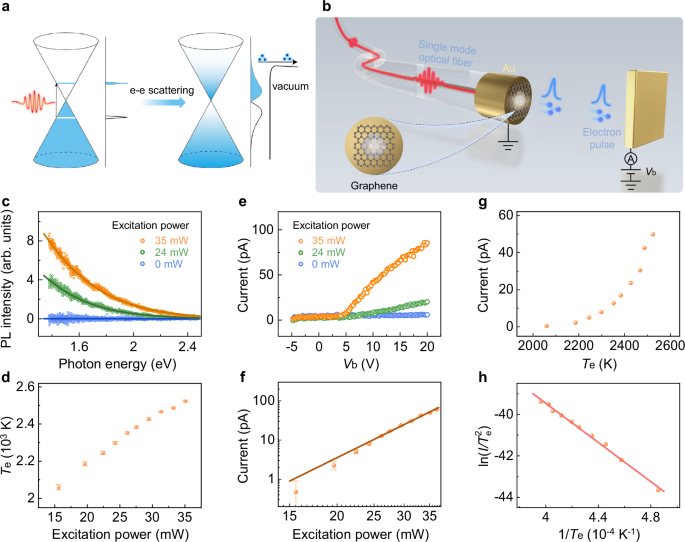
Through systematic optoelectronic measurements, the study revealed the physical mechanism of hot electron emission. The broadband photoluminescence spectrum of graphene (ranging from near-infrared to visible) follows Planck's blackbody radiation law, and temperature parameter extraction confirmed a strong correlation between electron temperature and excitation power. Current-voltage characteristic tests showed that the emission current increases sublinearly with bias voltage, consistent with the description of the Richardson-Dushman equation for thermionic emission. Notably, under excitation with different photon energies of 1.55 eV and 0.8 eV, the slopes of the current-power dependence were both approximately 4.8, ruling out the possibility of multiphoton emission or photoelectric effects. By fitting with the Richardson-Dushman equation, the research team precisely determined the work function of graphene to be 4.1 eV, which is in excellent agreement with the theoretical value for suspended graphene, confirming the dominance of the thermionic emission mechanism.
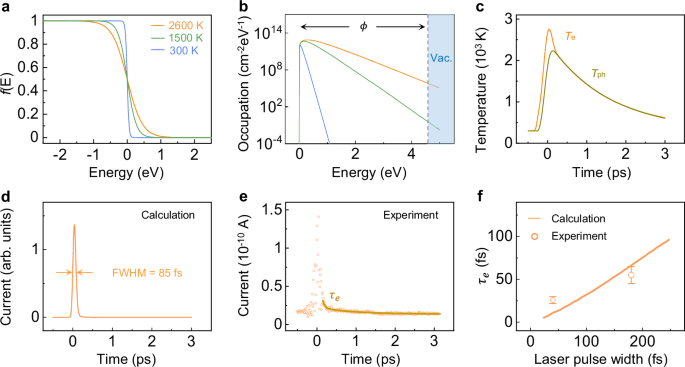
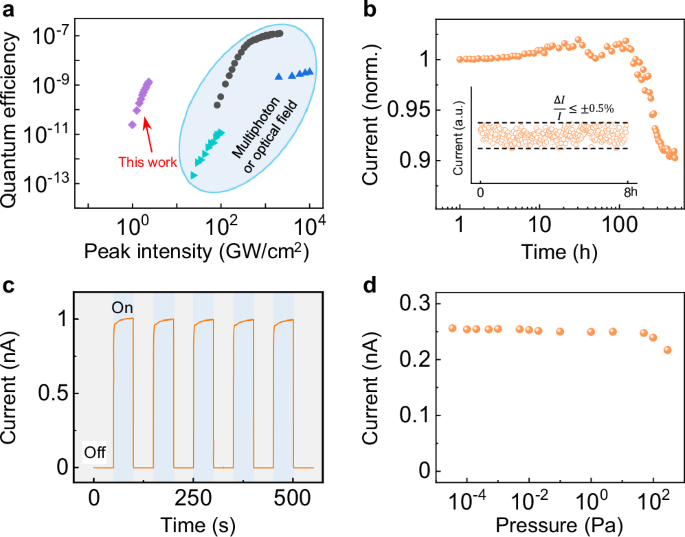
In terms of performance characterization, this electron source demonstrated groundbreaking stability metrics. Benefiting from the structural stability of graphene carbon bonds and the vibration suppression characteristics of the optical fiber, the current fluctuation remained within ±0.5% during continuous operation for 8 hours at a laser intensity of 2.2 GW/cm², with a T90 lifetime of up to 500 hours, far exceeding that of traditional metal photocathodes. The device maintained stable emission over a wide pressure range from 10⁻⁵ to 100 Pa, breaking the limitation that ultrafast electron sources must rely on ultra-high vacuum (on the order of 10⁻⁷ Pa). This stability stems from the special advantages of the thermionic emission mechanism: the laser energy primarily heats the carriers rather than the lattice (lattice temperature <400 K), avoiding thermal damage to the material; meanwhile, the fixed optical path design of the optical fiber eliminates the focus drift problem of free-space optical systems.
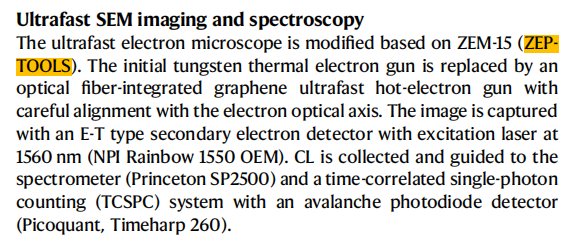
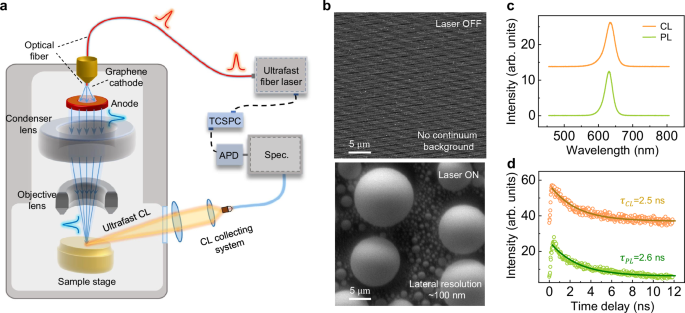
The study finally demonstrated the practical application of this electron source in ultrafast electron microscopy. The team retrofitted the fiber-integrated graphene electron gun into a ZEPTOOLS ZEM15 desktop scanning electron microscope, successfully achieving time-resolved imaging and cathodoluminescence spectroscopy measurements. With the laser turned on, the system obtained secondary electron images with an excellent signal-to-background ratio and a spatial resolution of 100 nm. Cathodoluminescence tests on CdSe/ZnS quantum dot films showed that the time-resolved spectra (2.5 ns decay lifetime) were in excellent agreement with photoluminescence results, verifying the reliability of the electron source for ultrafast spectroscopic analysis. This modular design provides a convenient path for upgrading conventional electron microscopes with ultrafast functionality, avoiding complex system reconstruction.
The ZEPTOOLS ZEM series desktop scanning electron microscope is a highly integrated, portable, and cost-effective scientific research instrument. It features fast pump-down, high imaging speed, and a variety of signal detector options, making it suitable for morphological observation and compositional analysis, as well as adapting to various in-situ experimental needs. The instrument has low requirements for the installation environment, is not sensitive to floor level, and is easy to operate, allowing non-specialists to quickly become proficient. Moreover, its purchase and maintenance costs are lower than those of floor-standing scanning electron microscopes, making it one of the preferred instruments for many universities, research institutes, and enterprises.

Related News

Contact Us
Mobile Phone: 15756003283
Email: support@zeptools.com、micage@zeptools.com
Address: No.15, Electronic Venture Park, Dongshi, Tongling City, Anhui Province, China