



Nature Nanotech.: In-situ quantification of branched crystal growth stress in lithium batteries reveals why lithium dendrites can pass through solid electrolytes.
Release time:
2020-01-16
Use of PicoFemto®In situ sample rod published research results continue to update, the future small series will continue to update product application cases. Teachers who missed the previous report can also click "previous articles" on the front page of the public number to read. You are also welcome to pay attention to the public number. Here are the cutting-edge information in the field of electron microscopy, special experimental schemes and high-level research results. Come and open your brains with your friends.
Use of PicoFemto®In situ sample rod published research results continue to update, the future small series will continue to update product application cases. Teachers who missed the previous report can also click "previous articles" on the front page of the public number to read. You are also welcome to pay attention to the public number. Here are the cutting-edge information in the field of electron microscopy, special experimental schemes and high-level research results. Come and open your brains with your friends. Lithium metal has attracted the attention of industry and academia due to its high specific capacity (about 3860 mAh/g), and is one of the ideal anode materials for the new generation of batteries. Due to the strong chemical activity of lithium metal, when lithium metal is used as an electrode, it is easy to have side reactions with the electrolyte to form lithium "dendrites", which greatly reduces the coulombic efficiency and cycle life of the battery. In addition, uncontrollable lithium "dendrites" can break through the separator, causing internal short circuits in the battery, leading to battery failure. The use of mechanically rigid solid electrolytes to inhibit the growth of lithium dendrites has attracted the attention of many researchers. However, lithium metal can still penetrate solid-state electrolytes, and solving this problem requires a basic understanding of lithium dendrite growth and related mechanical behavior.
To this end, Associate Professor Tang Yongfu of Yanshan University, Professor Zhu Ting of Georgia Institute of Technology, Professor Sulin Zhang of Pennsylvania State University and Professor Huang Jianyu of Yanshan University/Xiangtan University skillfully used the PicoFemto launched by Ze You Technology (ZepTools).®In situ mechanical and electrical integrated sample rod, the lithium whisker morphology was observed in situ growth, and its stress was measured. Relevant research results are published in the authoritative international journal Nature nanotechnology under the title of "Lithium whisker growth and stress generation in an in situatomic force microscope-environmental transmission electron microscope set-up. (2019 IF = 33.407) In this article, Dr. Zhang Liqiang and Dr. Yang Tingting are co-authors of the paper.
Original: https://doi.org/10.1038/s41565-019-0604-x
Researchers found that at room temperature, when a voltage (overpotential) is applied to the AFM tip, submicron whiskers begin to grow, and the growth stress during this growth process is as high as 130 MPa, which is much higher than previously reported. In addition, they also found that the yield strength of Li whiskers under pure mechanical load can reach 244MPa.
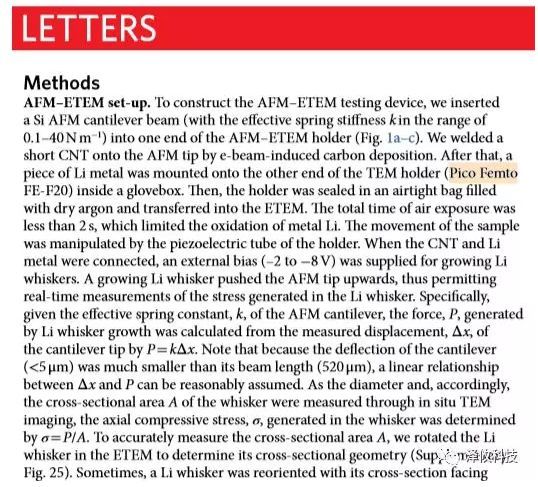

Figure: Experimental Method and Construction of Experimental Environment
This experiment uses PicoFemto®In situ force-electricity integrated sample rod and FEIETEM combination to build an experimental test environment. Among them, the elastic coefficient of the cantilever beam of the AFM probe in the force pole is selected to be 0.1 - 40 N/m. The authors welded carbon nanotubes to the position of the tip of the AFM probe by electron beam induced carbon deposition. Thereafter, a piece of lithium metal was mounted on the other end of the in situ electrokinetic sample rod inside the glove box. The sample rods were sealed in a sealed bag filled with dry argon and transferred to the ETEM. The total time of air exposure is less than 2 seconds, thereby limiting oxidation of the lithium metal. movement of the sample by the PicoFemto®Three-dimensional manipulation probe control of in situ force poles. When the carbon nanotubes and lithium metal are connected, an external bias voltage (-2 to -8v) is provided for the growth of lithium whiskers. The growing lithium whisker pushes up the tip of the atomic force microscope, allowing real-time measurement of the stress generated in the lithium whisker. Specifically, given the effective spring constant k of the AFM cantilever, the force P generated by Li whisker growth is calculated from the measured displacement Δx of the position of the cantilever tip by P = kΔx. Note that since the deflection of the cantilever beam (<5um) is much smaller than its beam length (520um), it is reasonable to assume Δx and P. By measuring the diameter of the whisker in the in situ TEM imaging and correspondingly measuring the cross-sectional area A of the whisker, the axial compressive stress generated in the whisker is determined with SiG = P/A to accurately measure the cross-sectional area A, we rotate the lithium whisker in the ETEM to determine its cross-sectional geometry. During the whisker growth, the current in the whisker was recorded with an ammeter, which read about 1.2 × 10⁻¹⁰A (Supplementary Figure 28). When the whisker diameter is about 700 nm, the current density is about 31 mA cm-2, which is comparable to traditional lithium-ion batteries.
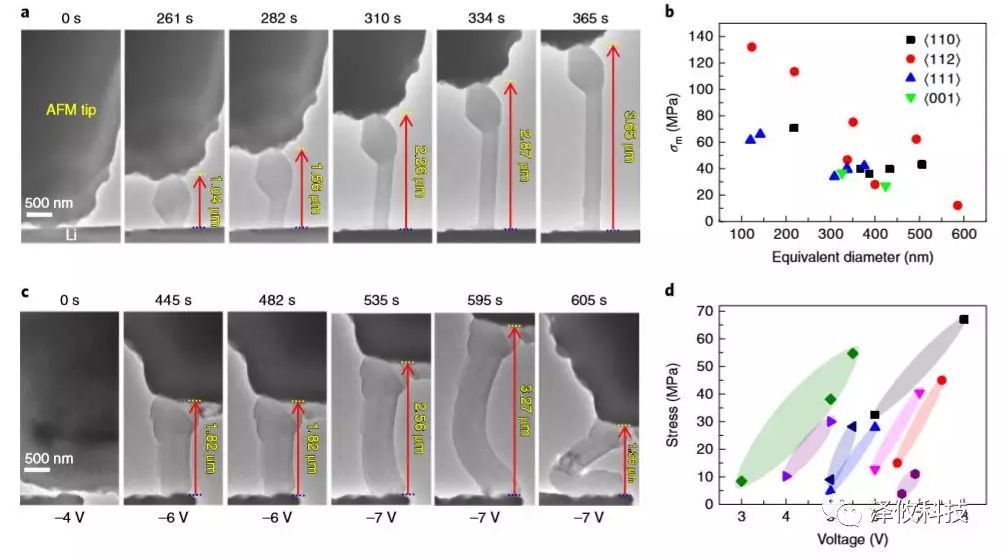
Figure 2: In-situ AFM-ETEM imaging of lithium whisker growth and simultaneous measurement of stress changes in lithium whiskers under applied voltage.
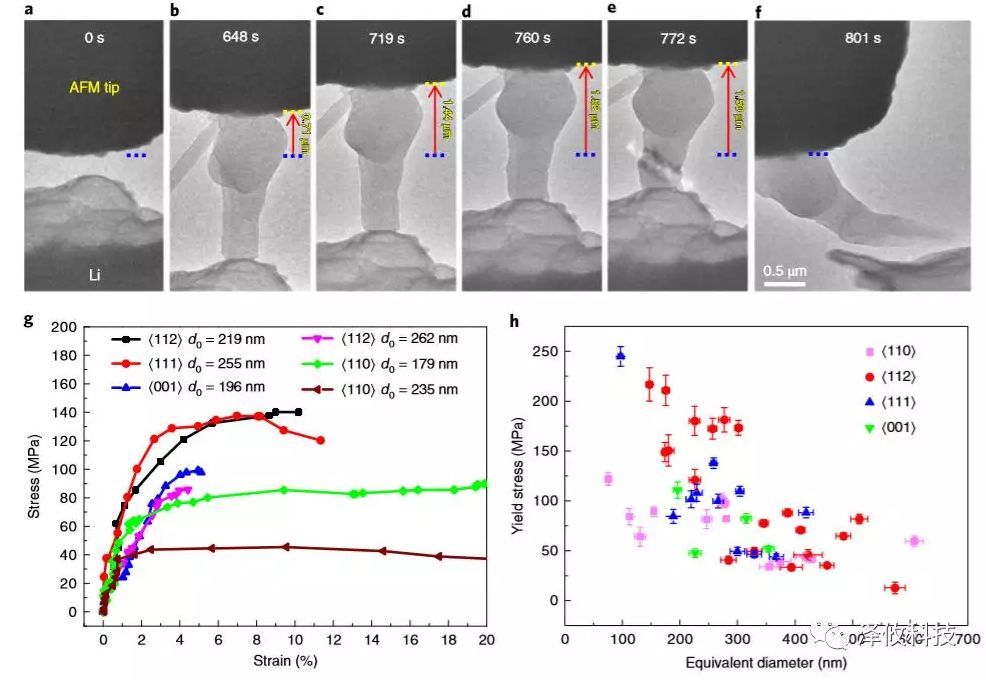
Figure: In-situ Compression Test of Grown Lithium Whiskers
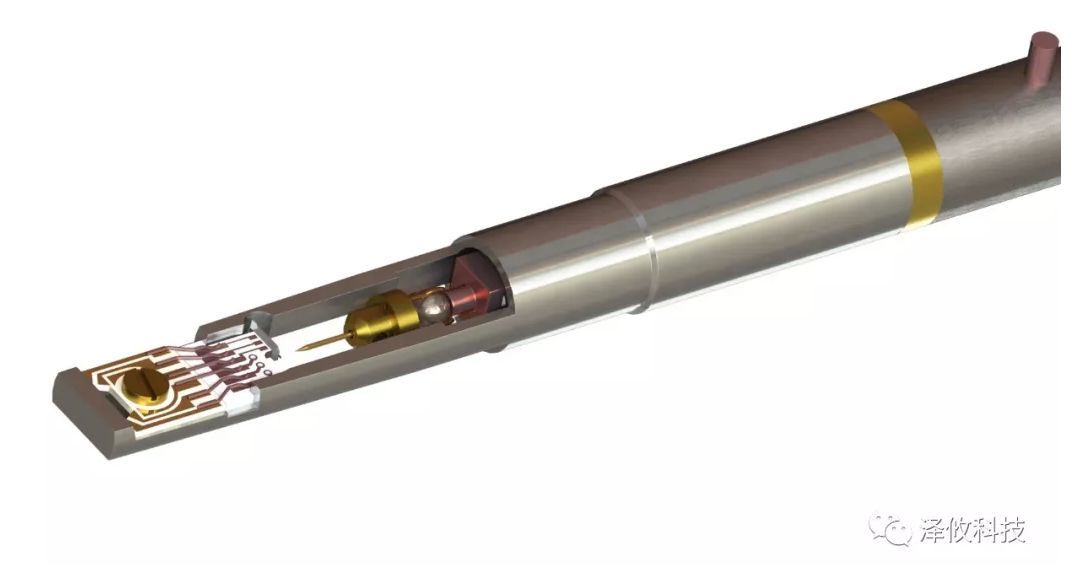
Figure: PicoFemto Reported in®In-situ force-electric integrated sample rod
Related News
Share

Contact Us
Mobile Phone: 15756003283
Email: support@zeptools.com、micage@zeptools.com
Address: No.15, Electronic Venture Park, Dongshi, Tongling City, Anhui Province, China