



From Physical Masks to Digital Light Fields: How Maskless Lithography is Reshaping the R&D Paradigm in Micro- and Nanofabrication
Release time:
2025-09-24
In the field of micro-nano engineering, the chasm between a CAD-based digital design and a functional physical device is bridged by a series of precision manufacturing processes, among which photolithography is undoubtedly the cornerstone for defining device geometry. For enterprises with decades of technological expertise in electron microscopy and in-situ measurement systems, the expansion of their capabilities often follows a clear physical principle—evolving from "observing" the microscopic world to "transforming" it. Driven by this logic, advanced micro-nano fabrication solutions have emerged.
In the field of micro-nano engineering, the chasm between a CAD-based digital design and a functional physical device is bridged by a series of precision manufacturing processes, among which photolithography is undoubtedly the cornerstone for defining device geometry. For enterprises with decades of technological expertise in electron microscopy and in-situ measurement systems, the expansion of their capabilities often follows a clear physical principle—evolving from "observing" the microscopic world to "transforming" it. Driven by this logic, advanced micro-nano fabrication solutions have emerged.

As the gold standard of the semiconductor industry, traditional photolithography based on physical photomasks has demonstrated unparalleled efficiency and consistency in mass production. However, when we shift our perspective from large-scale production lines to research and development environments, which are centered on exploration, iteration, and validation, this mature paradigm reveals its inherent limitations. This article aims to delve into this "paradigm mismatch" and systematically explain how Spatial Light Modulators (SLMs), represented by the Digital Micromirror Device (DMD), are driving the development of maskless lithography, thereby providing a more agile, flexible, and powerful microfabrication solution for cutting-edge research and engineering development.
I. The Core Logic of Traditional Lithography: Pattern Transfer Based on Physical Photomasks
Fundamentally, traditional photolithography is a high-precision pattern replication technique. Its physical process can be broken down into several key steps:
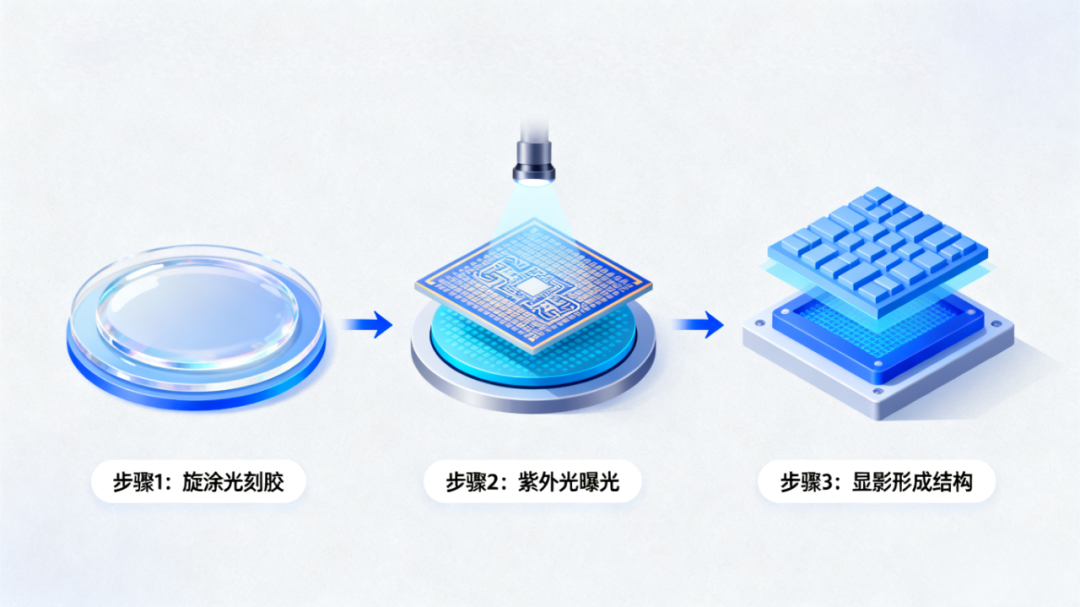
This photoresist structure then serves as a "temporary mask" for subsequent processes such as etching, thin-film deposition, or ion implantation. In this traditional lithography workflow, the physical photomask is the core bridge and the sole pattern carrier connecting the digital design to the physical world—it is a high-precision, static, physical pattern database. It is this core characteristic that gives rise to three structural challenges in an R&D environment.
II. Structural Challenges in an R&D Environment: Constraints of Cost, Cycle Time, and Functionality
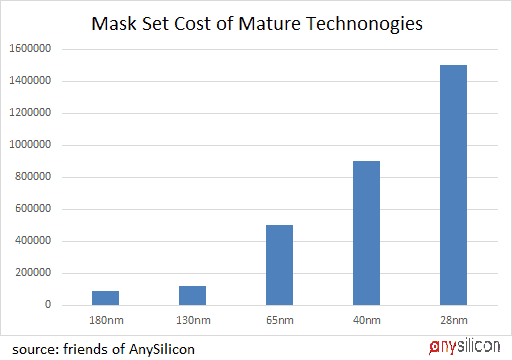
1. High Non-Recurring Engineering (NRE) Costs
The fabrication of a photomask involves high-resolution electron beam lithography, precision wet/dry etching, and rigorous defect inspection. Its manufacturing cost, the non-recurring engineering (NRE) cost, represents a significant initial expense in R&D. For research projects that require parallel validation of multiple designs or parameter sweeps, customizing a set of masks for each design variable leads to a linear, or even stepwise, increase in costs. This directly inhibits the breadth of exploratory experiments.
2. Long Design-to-Validation Cycles
The reliance on an external supply chain for photomasks results in long delivery times. The period from finalizing a design to receiving the physical mask typically takes several weeks. This severely prolongs the "design-fabricate-test-optimize" iteration loop, forcing an agile R&D process to incorporate a high-inertia "waterfall" stage. In time-sensitive frontier research, this delay can lead to missing critical innovation windows.
3. Inflexible Pattern Modification
The static nature of physical photomasks makes them unable to accommodate the frequent design changes required during R&D. Any minor adjustment means scrapping the old mask and fabricating a new one.
III. The Digital Revolution: Dynamic Pattern Generation Based on Spatial Light Modulators
To overcome the aforementioned bottlenecks, a "direct-write" technology that requires no physical mask and is driven directly by digital signals has emerged, with the Spatial Light Modulator (SLM) at its core. Among SLMs, the Digital Micromirror Device (DMD) is the most widely used and mature technology.
A DMD is essentially a semiconductor optical switch array, integrating millions of independently and rapidly tiltable micrometer-sized mirrors on a CMOS substrate. Each micromirror represents a pixel and has three precisely controlled states:
The workflow of a maskless lithography system represents a reconfiguration of the traditional lithography paradigm:
CAD Data -> Rasterization -> DMD Driving -> Dynamic Light Field Formation -> Projection Exposure
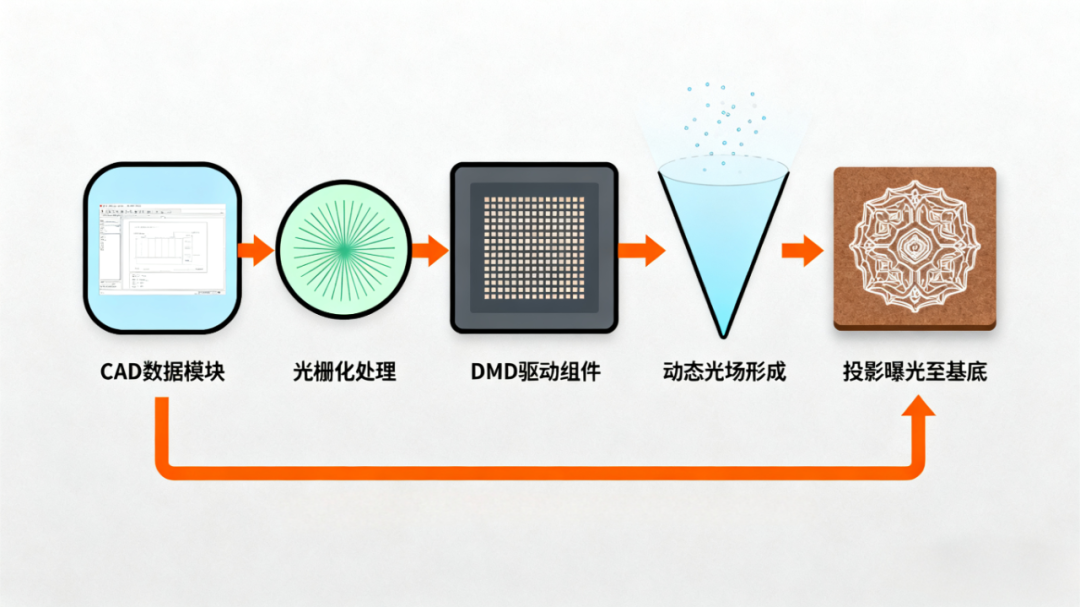
A design file (e.g., GDSII, DXF) is first rasterized by software into bitmap information. This information is loaded in real-time into the DMD controller, which drives millions of micromirrors to flip in coordination at microsecond speeds. At the moment of exposure, this generates a dynamic binary light field corresponding to the design pattern, which functions as an instantly refreshable "virtual mask." This light field is then scaled by a projection objective system and directly writes the pattern onto the photoresist.
IV. Technological Advantages and Frontier Applications: Reshaping the R&D Paradigm
This shift from a "static physical template" to a "dynamic digital light field" brings a multi-dimensional leap in capabilities for micro-nano fabrication R&D.
1. Enabling True Agile Development and Rapid Prototyping
The most significant advantage is that the cost of design modification is virtually zero. Researchers can complete the entire process from design change to re-exposure within minutes. This makes parametric scans effortless. For example, when designing a microfluidic mixer, a series of devices with different channel widths and intersection angles can be rapidly fabricated to drive design optimization with experimental data. In the study of MEMS resonators, the geometric parameters of cantilever beams can be quickly iterated to find the optimal frequency response. This capability liberates the R&D process from the traditional "waterfall model" and ushers it into a highly efficient "agile model."
2. Unlocking Grayscale Lithography to Empower 3D Micro-Nano Fabrication
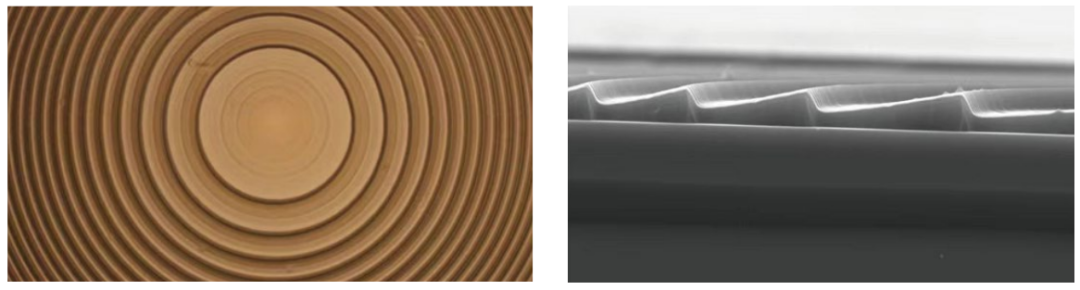
The digital nature of the DMD enables high-precision grayscale exposure through Pulse-Width Modulation (PWM). Within a single exposure cycle, by precisely controlling the proportion of time an individual mirror spends in the "On" state (i.e., the duty cycle), the cumulative light dose received by that pixel can be linearly modulated. After development, areas of the photoresist that received different light doses will have different remaining thicknesses. This capability is a powerful tool for fabricating complex 3D microstructures. For example, in the field of micro-optics, a Fresnel lens or diffraction grating with a continuous curved surface can be fabricated in a single exposure by generating a precise grayscale pattern. The performance of such components is far superior to the stepped-profile approximations created through multi-step binary lithography.
3. Fostering New "Hybrid Lithography" Strategies
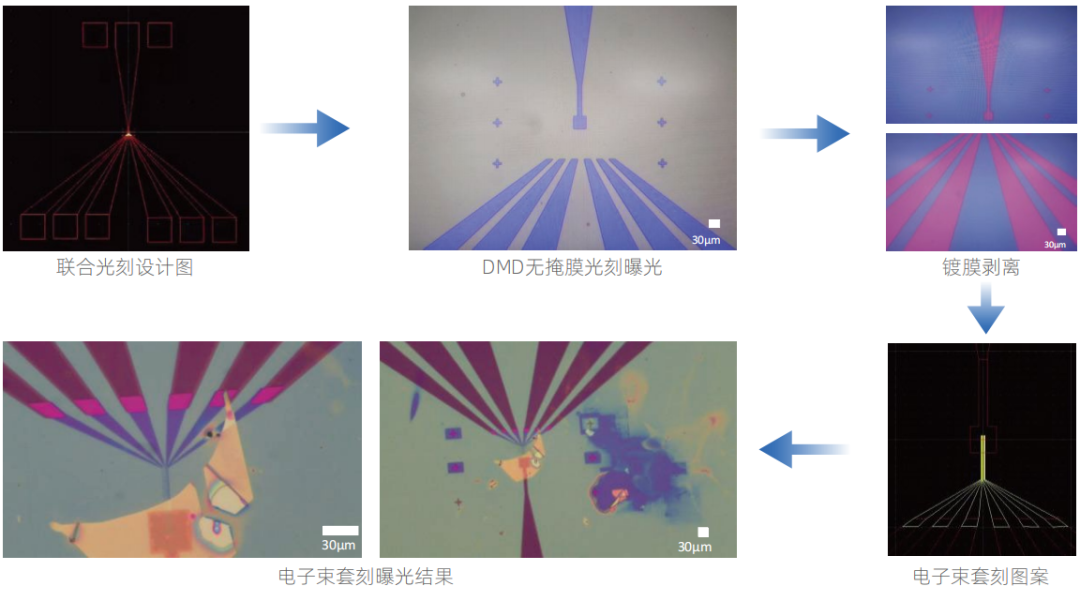
In the R&D of many high-end devices, structures with vastly different precision requirements often coexist. For example, a typical quantum computing chip or a high-frequency Gallium Nitride (GaN) HEMT device has micrometer-scale electrode leads and bonding pads that occupy most of the area but have relatively relaxed linewidth control requirements. However, its core components, such as the Josephson junction or T-gate electrode, are on the nanometer scale and demand extremely high precision.

This is where the "hybrid lithography" (or "mix-and-match lithography") strategy comes into play. It advocates for using different technologies to process different levels of structures to achieve a globally optimal balance of efficiency, cost, and performance. In practice, a DMD-based maskless lithography system (such as the ZEPTOOLS ZML series) can be used first to efficiently complete two core tasks: first, the high-speed, large-area patterning of all non-critical micrometer-scale structures; and second, the fabrication of high-precision, high-contrast alignment marks for subsequent nanometer-scale lithography. Following this, an electron beam lithography system (such as the ZEPTOOLS ZEL304G), with its ultra-high resolution, can perform precise overlay writing of the nanometer-scale core patterns within the critical areas defined by the DMD lithography, using the previously created alignment marks for accurate positioning. This strategy seamlessly integrates the high throughput of DMD lithography with the high resolution of EBL, creating a deeply complementary workflow that has become a highly efficient and economical solution in frontier device R&D.
Conclusion
Maskless lithography, by introducing a spatial light modulator into the optical path, has achieved a fundamental transformation from a static physical mask to a dynamic digital light field. It not only solves the bottlenecks of cost, cycle time, and flexibility faced by traditional lithography in the R&D phase but also expands the boundaries of micro-nano fabrication processes through new capabilities like grayscale and hybrid lithography. For engineers and researchers on the front lines of innovation, it is no longer just a fabrication tool but a powerful platform that seamlessly connects digital design with physical validation—a true "accelerator" that pushes the speed of R&D iteration to new heights, allowing more innovative ideas to be realized faster and more freely in the microscopic world.
Related News

Contact Us
Mobile Phone: 15756003283
Email: support@zeptools.com、micage@zeptools.com
Address: No.15, Electronic Venture Park, Dongshi, Tongling City, Anhui Province, China